
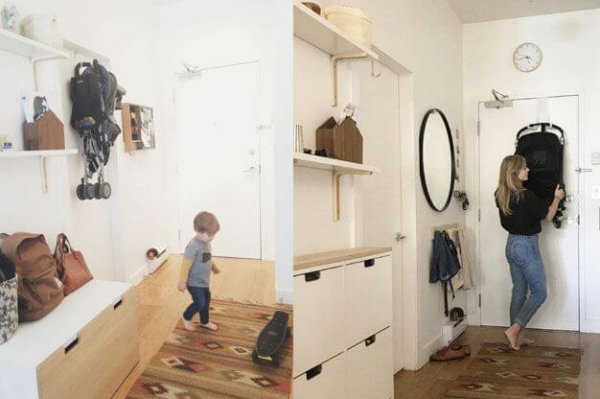
A stroller is bulky, awkwardly shaped, and often needed at exactly the moment everyone is trying to leave the house. Stroller storage ideas for homes without large entry closets should make access easier without blocking doors or swallowing valuable floor space. The best solution usually depends on how often the stroller is used and whether it folds compactly.
Store Daily Strollers Near the Exit
If the stroller goes outside almost every day, storing it deep inside a bedroom or basement creates unnecessary work. Look for space beside the main entrance, in a mudroom, under stairs, or near a garage access door.
Measure the stroller both open and folded. Many storage plans fail because people estimate its size instead of checking the widest wheels, handle, and folding mechanism.
Protect the walking route
Leave enough clearance for people to pass comfortably. A stroller shouldn’t become an obstacle during rushed departures, especially when someone is carrying a child, bags, or groceries.
Use Vertical Space Carefully
Wall-mounted hooks can work for lightweight folding strollers when the manufacturer permits that storage position and the wall fixing is appropriate. Keep the stroller high enough to free the floor but low enough that lifting it doesn’t become a daily struggle.
People researching residential property layouts may find that unused vertical zones are common in smaller homes. Still, not every stroller is suited to hanging, particularly heavier models or designs with awkward folding points.
Turn Furniture Into a Storage Boundary
A console table, narrow shelving unit, or freestanding screen can visually separate stroller parking from the main room. This works well in apartments where the front door opens directly into a living area.
Thinking in zones, similar to ideas found in home and land planning material, can help prevent the stroller from migrating across the room. Give it one defined footprint and avoid allowing bags, shoes, and packages to slowly take over that space.
| Storage Option | Best For | Main Limitation |
|---|---|---|
| Wall hook | Light folding stroller | Requires lifting |
| Under-stair space | Medium or large stroller | Access may be tight |
| Entry parking zone | Daily use | Uses floor area |
| Garage wall area | Outdoor access | Less convenient indoors |
Consider Storage for Wheels and Accessories
The stroller isn’t the only item that needs a home. Rain covers, foot muffs, cup holders, blankets, and stroller organizers can create almost as much clutter.
Use one labeled basket or shelf nearby rather than leaving accessories attached all the time. Damp rain covers should dry before being folded into enclosed storage.
Where Stroller Storage Plans Go Wrong
The most common problem is optimizing for appearance instead of convenience. Hiding the stroller behind several doors may create a cleaner entry but turn every trip outside into a small moving project.
Another issue is blocking circulation. Good spatial and outdoor design thinking often depends on keeping movement routes open, and compact interiors benefit from the same discipline. A stroller spot should sit beside the traffic path rather than inside it.
Frequently Asked Questions
Can a stroller be stored outside?
Only if the location protects it from weather, moisture, theft, and damaging temperature conditions. Indoor or secure covered storage is usually easier on fabrics, moving parts, and accessories.
Is hanging a stroller on the wall practical?
It can be for lightweight folding models. Check the stroller’s weight, choose suitable hardware, and make sure the lifting motion is comfortable enough for regular use.
How much space should I reserve for stroller storage?
Measure the folded stroller at its widest, tallest, and deepest points, then add enough clearance to remove it without scraping walls or shifting nearby furniture.
Give the Stroller a Permanent Address
Small homes feel more organized when bulky items stop drifting from room to room. Measure the stroller, choose a location close to the exit, and protect the walking path before adding organizers. A modest, clearly defined parking area is often more useful than an elaborate hidden solution. The easier the stroller is to put away, the more likely it is to stay there.